


The pearly gloom of a Parisian winter afternoon flooded the room as he gazed down at the plaza to observe the moving city in miniature. While the whole organism of city life could be seen at once, no part of it could stay still or be fixed: rooflines dissolved at their edges, and horse-drawn carriages moved through the square while pedestrians shuffled among them, their bodies reduced by height and distance to quick, anonymous flecks of blue and umber. A pink and violet fog softened all motion into memory, and the streets yonder blurred into gauze.
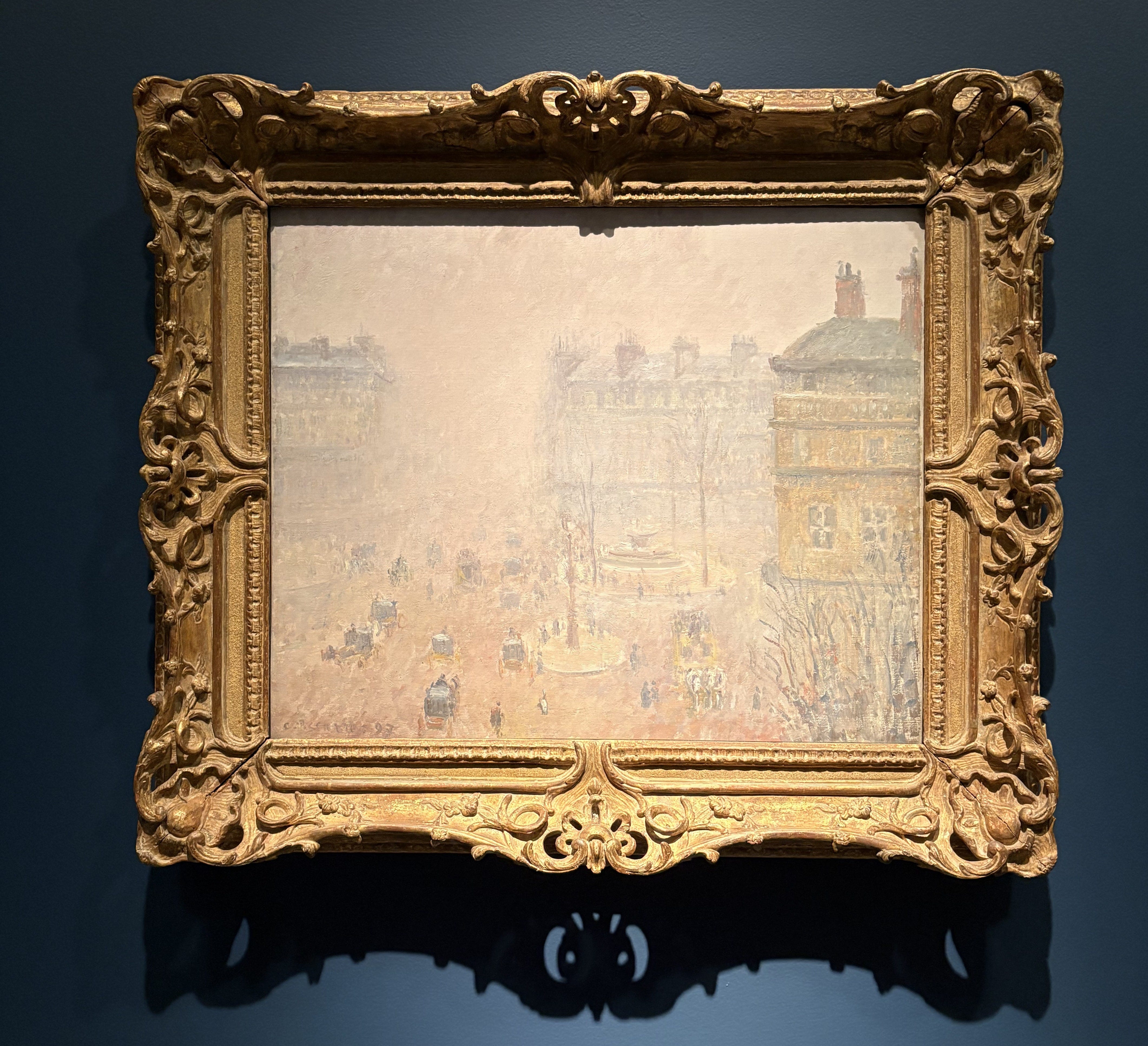
Camille Pissarro’s Place du Theatre Francais, Fog Effect was painted in December, 1897, and it has no interchangeable unit. Another painter might have stood in the next room on that exact same day, looked upon the same square at the same hour, and depicted another world entirely. Were the easel to move three inches to the left, had a person on that street made a right turn instead of a left, and the whole thing changes beyond recovery. This fluidity of the scene meant that what was captured was truly a blink in time, and what art rescues from time is exactly what cannot be substituted: its unrepeatable occurrence, the world as it passed once through a particular consciousness and nowhere else.
More than a century later, on a warm October afternoon, I stand in front of this time machine of a painting, in the impossible position of looking out with Pissarro. I see this particular hazy day in Paris, seen through this window of the Hôtel du Louvre, by this pair of eyes, and painted by this person.
The simple answer to “can machines make art” is “no”, but it doesn’t mean that machines can’t produce pretty things. Discourse about whether or not machines can create art skip a more important question: Why do we have to anthropomorphize machines in order to think about them? Or, why do we have to dehumanize people in order to understand machines?
Italian philosopher Giambattista Vico once said, “Man in his ignorance makes himself the rule of the universe.” We assign human traits to foreign things in order to make them familiar—the book has a “spine”, the needle has an “eye”, the machine has “intelligence” and can “think”.
But, a machine does not “think”—this is the anthropomorphized term we use to describe what looks like thinking due to its conversation-like interface. (We rarely talk about self-driving cars like this probably because they do fewer “human” things like respond to a text message emotively, yet they’re as sophisticated as a chatbot).
‘Liked’ by half a million people, the Pope tweeted, “There is an ontological difference, even before an aesthetic one, between art and what a machine can generate”. The “ontological difference” here (that seems to be flying over the heads of the rationalist-atheist type) means that while AI is definitely a better painter than most of us, it does not make AI-painting “art” because technical skill is not the soul of art. The soul of art is will. It’s what Beethoven meant by “Playing a wrong note is insignificant but playing without passion is inexcusable”.
What makes art human is not technique but the fact that it is a gift: it turns one person’s encounter with the world into something another person can receive, and its value grows in this transmission. Even when art is created for no one in particular, the artist creates as a way of expression, and all expression is an attempt to reach a hypothetical somebody, for the chance of being understood or related to. Art is necessarily about interpersonal connection: “And when we’re inspired enough, we reach out from this primal loneliness to other lonelinesses in that great gesture of connection we call art.” (from: On Loneliness and Art)
Commodity vs. Gift
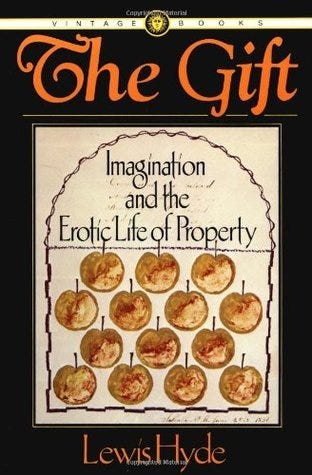
The fruits of creativity exist in a moral economy different from ordinary goods. Commodity exchange defines a transaction: you give me a shirt, I give you $20 and now we don’t owe each other anything. A commodity exchange creates a boundary between people. Creative work exists as gifts: when you give a gift, the other person is “indebted” to you (i.e., there is some kind of net inequality). For example, when we catch up with a friend over lunch and they take care the bill (“don’t worry, it’s my treat!”), a sense of reciprocity is created—a gift exchange creates bonds between people. When someone tells us a really touching story, we are left feeling indebted to do something with that feeling we so-often call “inspiration”—the gift economy describes the human urge to pass it on, or pay it forward. A gift, by definition, is something you get not because you deserve it but because someone wanted to give it to you, with no expectations of getting something in return. They didn’t have to, yet they did it anyway.
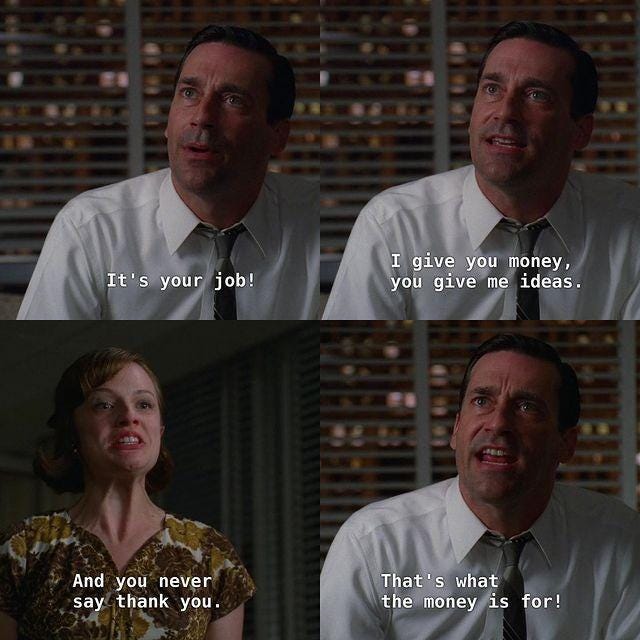
Creativity is a human-to-human enterprise, and the purpose of the gift economy is not transferring objects between people but transforming relationships.
This is the “spark” we say when we refer to humanity in general, and it’s the “spark” in the Pope’s tweet: things like art, imagination, love, grace, knowledge, and talent are all gifts because their value increases when given away rather than being possessed like an object (for example, a person can only be hospitable if they frequently give hospitality to other people—you can’t hoard hospitality).
This is also why we speak of talent as a gift—the artist actually owes it to the world to use it and create. The point of talent is to give it away. In ancient Roman belief, genius (Latin, genius, guardian spirit) was not something you were, but something you had, like a separate entity that transmitted inspiration and insights into your mind. Art can be an intense responsibility for those who have the gift of creating it, and this responsibility doesn’t occur in commodity exchange because a completed transaction leaves both parties independent from each other.
The two lives of art
Creative things like art, movies, and books tend to have two parallel lives: they are a commodity—they can be priced, marketed, and sold—but its cultural life follows gift logic. This is why the beauty or spiritual change we encounter in books and movies feels incapable of being captured by a price tag; we cannot economically assess the heart-throbbing pain we feel at the end of La La Land, and we largely believe that there’s something subjective about art because art can speak to each of us so differently.
Lewis Hyde’s original (and better) title describes the characteristic of gift giving as “erotic” (a subtitle that did not fly under the editorial pen of puritanical North America). A gift is a thing animated with Eros—desire. The most inner spirit of gifts is wanting: you gift things because you want to. Of course, creatives are also driven by profit incentive, but commercialization does not diminish the second life of art, or, the soul of creation, which is pure want: Nobody is forced to be an artist. This feeling of having your heart pulled toward something that makes you feel more alive—this wanting—is what drives people to do anything, to create anything. Pissarro wanted to capture the ebb and flow of the city, and that was reason enough.
When people are upset at AI-generated images competing alongside human-made art, the disappointment is in the lack of pure desire: nobody is forced to create anything, so, the faux gift—a soulless product of a machine—feels like a rape of creativity, a corruption of that genuine desire to share human talent.
For the love of machines
Ayn Rand once called the New York City skyline “the will of man made visible”, similarly, I think that art is will made shareable—it’s the inner stirring of a person taking form in the world and becoming available to another person as a gift, a way of passing something forward and across. The morality of creativity must assume free will, where a person could have done nothing but instead followed an impulse to pick up a camera, draft a novel, or create a film. This is why will is the soul of art. Technique can be imitated, and even beauty can be standardized and measured, but creation contains that originating act of desire: I want to make this.
But… I love machines. The machine itself is born of human creation… so what’s to be said about that?
I wonder if imitating human art is not only an insult to artists, but a misuse of machines. I wonder if there are entirely novel art forms we have not yet experimented with by using machines, and that it’s our own imagination of what art could be that limits us to this short-circuited “creativity”. I guess the question, “What is the point of talent?” is really asking, “What should exist?”
What does human will accumulate toward? What is the purpose of machines—what are the purposes we give to them, and what do those desires ultimately point at?
~

this was beautiful, and answered a lot of my questions around my impulse to create. i guess i cannot negotiate myself out of it, but simply assume the responsibility of gift giving
I agree with you, was nodding my head while I was reading. There’s another dimension I’ve heard talked about, that ties a more to a person’s ego, which is a fear of erasure. If a machine can do something I can do (even if philosophically it’s only a simulacrum) and people are willing to accept it as such, does that mean my personal expression is devalued, and my life is less meaningful?
I think you are absolutely right about the community aspect of creation; talent is creative consciousness, concentrated at a specific point, and consciousness is in communion with another. The challenge is getting the other to accept you and validate your individual expression. If the world accepts machine art as such, it becomes harder to differentiate oneself from the world.