


The overarching theme of all my thoughts in the last two years have been around the ecosystem that attention, consumerism, mass media, and celebrity culture are all part of—specifically, where DESIRE sits in this ecosystem. I am giving a lecture on this topic in Toronto on September 10th. See season details or:
A man who dares to waste one hour of time has not discovered the value of life.
— Charles Darwin
I do coke, so I can work longer, so I can earn more, so I can do more coke.
— Kill The Noise lyrics
Advertisements are like pigeons: they’re all over the city, not directly violent, but extraordinarily bold in their willingness to be in your face and waste your time.
However, when done exceptionally well, ads are as amazing as art. In fact, they might as well be art—after all, what’s art for if it doesn’t teach us what to want? If it doesn’t change our intentions?
Economics is the study of managing infinite desires with finite resources. It follows a logic like physics: there’s a gravity and there are resistances, as well as laws about the nature of substances. In economics, a person is a “consumer”, meaning that human nature is measured by the gravitational force of consumption—the usage of something, the need to eat something‚ it’s why No Face in Spirited Away has no face: it is appetite itself, it is consumption, regardless of name or identity. Computers and duvets and haircuts and accountants alike are paid for, used, then rendered useless through our existential GI tract.
Our infinite desires are resisted by willingness: for example, my willingness-to-pay is the dollar equivalent of my desire for what you’re offering me. And if money is a storage of value and a medium of exchange, that means every transaction is an agreement where one person said “I want what you have more than I want the amount of my life this money represents.” In a way, everything you want is to die for, because the true measure of anything’s worth is the hours it takes for you to acquire it. Lifespan, economically speaking, is your ultimate wallet. Everything you own used to be money, which used to be your time.
Poverty is how much life you must spend to acquire things. You are as poor as how much of your life you must spend to have things, and you are as rich as how much of the world an hour of your life can buy.
The word “proletariat” comes from the Latin, proletarius, meaning “producing offspring.” In other words, the most original definition of the working class is those who own only the means of reproduction. A proletariat owns only his gametes—the resource of his own existence; the only thing he produces is more lifespans, more workers to take his place once he runs out of ‘life’ to spend on labor. (This is another topic, covered in: Transcending the Rat Race).
What does advertising have to do with this?
Advertising is predation on attention. If money is the storage of the value of time, then attention is time in its liquid, spendable form. All attention is potential wealth. Attention is the instantiation of consciousness—all experiences are temporary arrangements of attention. When I’m at a concert and I feel alive in the moment, it concretely feels like my attention has taken on a particular pattern. And over time, you are shaped by what you pay attention to.
Advertisements are intrusive by nature: they force you to watch it for a few seconds before a YouTube video; they take up your cognitive bandwidth by plastering your vision field while you stand on the platform and wait for your train; they pop out of silence while you wait for a customer support representative to answer the phone. It’s like advertisements are literally trying to kill you; they are trying to take away your time and attention, they are trying to tell you how to live. No wonder it’s so easy to overspend: we buy things we don’t need often because we are influenced into believing that owning that thing will change something about who we are.
Coca-Cola bottles. Campbell’s soup cans. Publicity photographs.
Andy Warhol started as a commercial illustrator then carried this craft into fine art, which, A) refuses to make a moral distinction between the things we buy (commerce) and the images we like (art), and B) showed that mass consumption has flattened an old hierarchy by giving millions of people access to the same desirable item; the President and a person with almost no money could drink the same Coke. A print, by definition, means that it is demanded by many, and anything that gets widely distributed becomes ordinary, and nobody understood ordinariness better than Warhol.
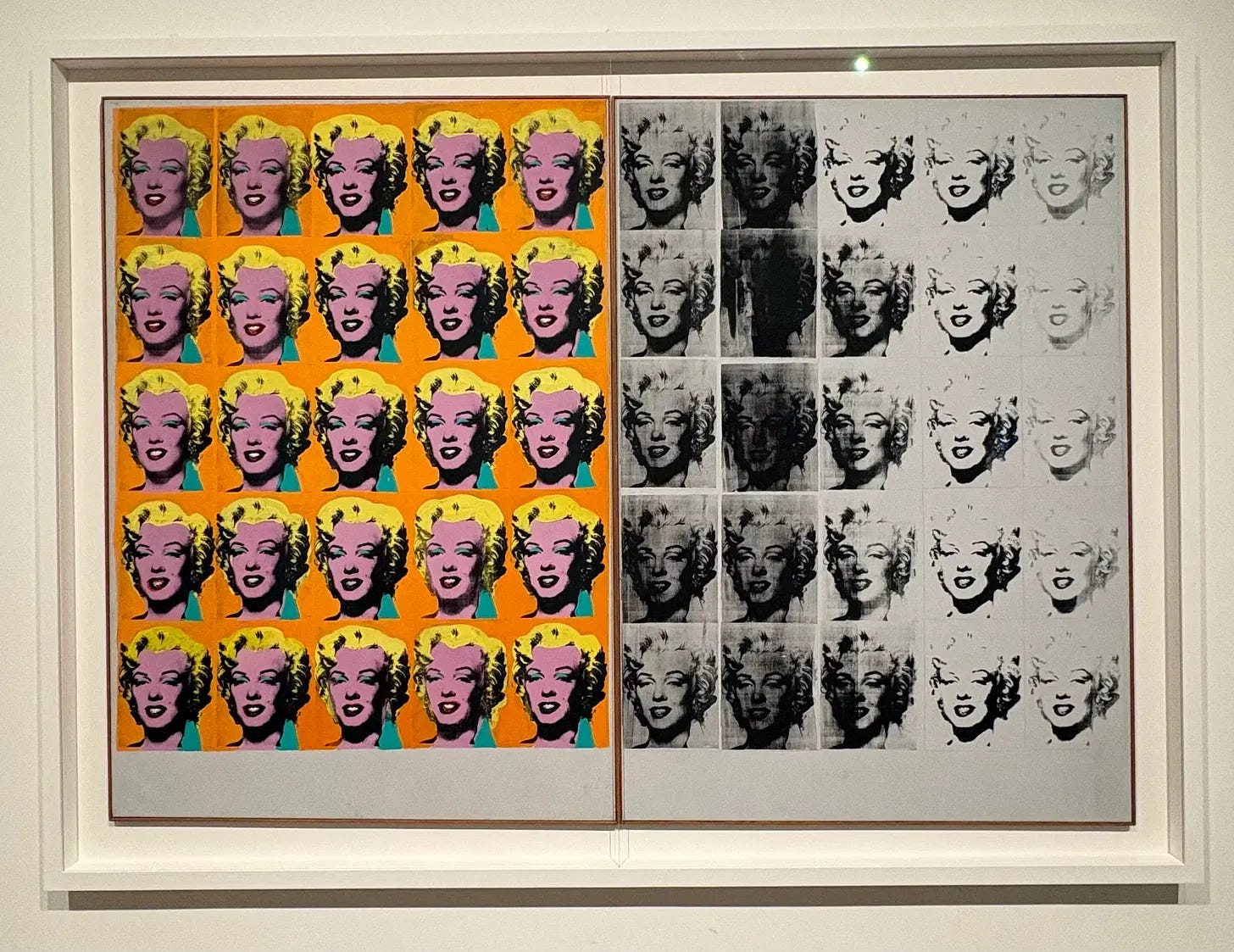
Mass media flattened another hierarchy: who gets to be looked at.
Warhol famously predicted that someday everyone would be world-famous for fifteen minutes: What if fame was also reduced to time, our common denominator across the whole world? To be famous is to occupy other people’s attention for some duration, and decades after Warhol in the age of the internet, not only has this happened but it has made “ordinariness” lose its meaning: ordinary teens became seriously famous via social media, and seriously famous teens proved themselves ordinary through candid photos of every-day life. Who needs the Hollywood promotion machine when anyone can cast, film, edit, and sell at home? While a camera doesn’t make everyone a Superstar (i.e., just because you can create an Instagram account doesn’t make you a photographer—if you don’t know what I’m talking about, see The machine in the garden.), mass media can make lowercase “s” stars out of ordinary people. OnlyFans, for example, has zero gap between the person, the advertisement, the product, and the seller. Even Substack has this OnlyFans-ification of content: I’m talking about that popular genre of monetized diaries, selling parts of the private life (“what I did this week”) in the name of “authenticity” and yet they still sound like they’re all living the same lives (“recommendations” and it’s East of Eden). Every platform feels like a printing machine, making nearly identical copies of one thing.
Fifteen minutes of fame turned out not to mean that everyone would become Marilyn but that everyone would have some capacity to shapeshift and monetize attention. We are all ordinary celebrities. Today, almost everyone can be an advertiser who can also be the advertisement. We package our looks, opinions, relationships, and sense of humor for other people’s attention, and occasionally that attention becomes money, but even when it doesn’t, it can become status—that we’ve become some kind of arbiter of “taste”—or proof that we’ve been noticed. Warhol’s world of products and celebrities has converged: the product can now be a person.
And so goes the saying, “if it’s free you’re the product,” meaning the user becomes used. I hate receiving targeted ads because they remind me of how predictable I am, because I have given so much of my attention to idols of influence. I hate that what I pay attention to on my feed turns me into a product; a consumer; a highly influenced and influenceable person who’s easy to squeeze life out of. When I find myself surrounded by ads, I feel like I’m being lowered into a pool of pirañas, countless little jaws vying for a bite of my attention and a little slice of my headspace, until there’s no quiet left.
I never think that people die. They just go to department stores.
— Andy Warhol
The word “advertise” means to direct someone’s attention toward something. Advertisements therefore are small proposals about who you should become—look here, desire this, be like her, work harder so you can have this. Decades will pass, time will materialize in your decisions, and your attention will write your biography. You eventually become someone who wants the things you are repeatedly told to notice (Marketing 101: Awareness comes before conversion).
But this is probably why I love advertising (and collecting good ones), because not only do ads reveal how suggestible we are, it exists to prove how important happiness is—that regardless of what Maslow’s pyramid says about our socioeconomic affordances, the consumer’s ultimate appetite is for a kind of joy that transcends material stuff and what money can buy: When we can’t identify unconditional happiness among the million little things that money can buy, or when we can’t form identities outside of the things we own, the things we own end up owning us. (from: On Not Having Enough Money)
Advertising has them chasing cars and clothes. A whole generation working in jobs they hate, just so they can buy sh*t they don’t really need.
— Fight Club screenplay
“Agency” is a precious word in the world of tech because it implies something like “thinking for yourself and becoming a ubermensch by transcending inefficient bureaucracy or outdated traditions.” But true freedom also need intention: you can be highly agentic and still not know what you want—what you want to glorify, why you want to build what you want to build, and exactly what kind of lifestyle you want to live—“every day is all there is,” said Joan Didion. Willpower needs steadfastness; freedom needs boundaries. Agency becomes easily exploited without intention. Freedom cannot mean never being influenced because that would mean never encountering anything.
~

When I saw the title of this article in my notifications I immediately jumped to read it, as it’s almost word for word something I’d say is central to my own way of thinking. However, after having read it, I felt it didn’t get to the core of the title and left wanting more to resonate with.
This article seems to highlight one specific aspect of the broader topic of “agency x orientation” which is specifically the idea of internally selected orientation vs externally imposed or osmotically received orientation.
I think it’s fully worthwhile to discuss that aspect, and I appreciate that it was, but I’d have loved to see more said about specifically the relationship between agency, orientation, and outcomes, rather than a primary focus on the warning against unconsciously received orientation.
The last two paragraphs felt like getting to the start of the meat but it was the end. Maybe the shape of the essay feels inverted to me, but that might be personal temperament/appetite for analytical explication as opposed to more of a short-form journey. I do think once it got to the explicit thesis at the end, I’d have liked to see more development of implications and application of the thesis.
I don’t say this hoping it comes off as critical so much as I think you have more to say! I’d love to hear you expound on this topic in the future. Thanks sherry :)
Treating attention as time in its liquid, spendable form is such a sharp framework. We guard our actual wallets with multi-factor authentication, yet routinely leave the vault of our cognitive bandwidth wide open for algorithms to raid.
If our daily attention is actively writing our biography, then scrolling without a clear intention is just letting strangers write our life story for us